What is Tunable White Lighting? Benefits & How it Works
Posted May 19, 2026 by Chris
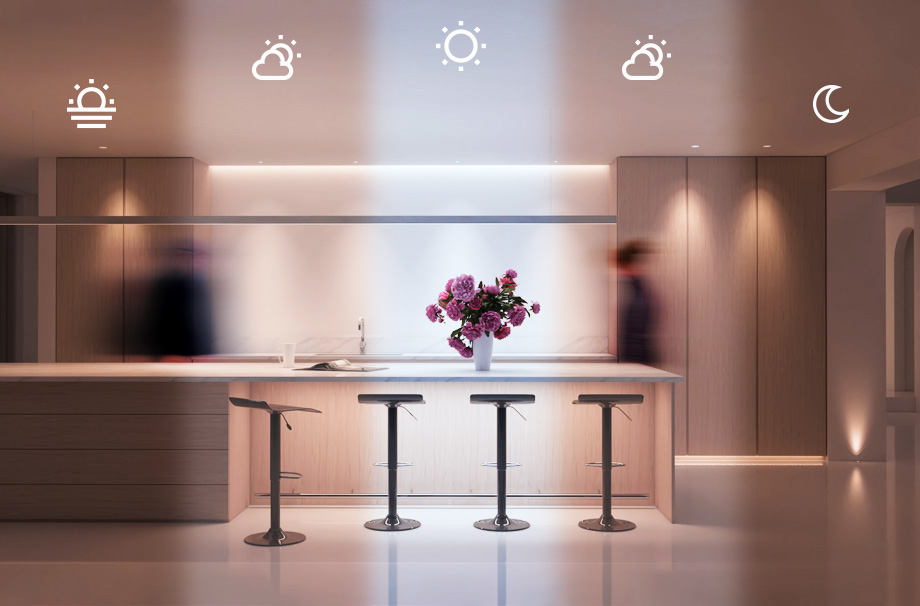
 |
Chris Director, Founder & Lighting Designer |
Lighting doesn’t just have to be ‘on or off’ any more. Tunable white lighting – also known as variable white, hybrid white or CCT adjustable lighting – works in harmony with our circadian rhythm by allowing us to adjust the correlated colour temperature (CCT) of white light within our interior space. Why does this matter? Tunable white light is the foundation of human centric lighting, a developing field within human-focused architectural design. We’ve seen the demand for tunable white fixtures rising rapidly, so let’s look at how this cutting-edge tunable lighting technology is revolutionising the way that we experience our indoor environments.
Table of Contents:

A woman enjoying the natural benefits of sunlight.
Tunable White Lighting: A Definition
Tunable white LEDs allow us to select the specific CCT (colour) of the white light in our indoor environment and also to change this colour whenever we choose – standard LED lighting cannot do this.
What is CCT? It’s a measurement of the colour of white light using the Kelvin (K) scale, for example:
- 2700K = warm white light
- 6500K = cool white light
Tunable white lighting is fully adjustable and has no fixed preset settings, e.g. ‘warm white’; it offers a continuous range of CCTs to choose from, which usually falls between 1800K (candlelight) to 6500K (daylight).
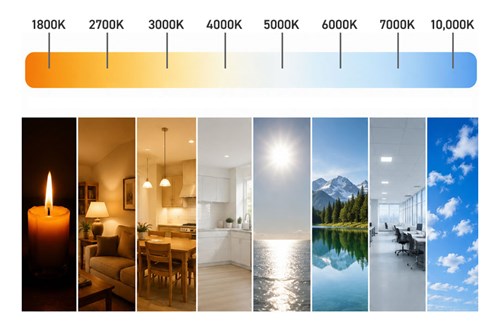
CCT diagram: tunable white typically covers 1800K-6500K.
Benefits of Tunable White Lighting
Wish that you could get the health benefits that sunlight has to offer whilst working and playing indoors? The emerging concept of human centric lighting (HCL) - also known as circadian, wellness or biodynamic lighting - is a combination of insightful design, natural daylight and dynamic, tunable electric light. Tunable white lighting used within an HCL scheme cannot replace full spectrum daylight entirely, but it can replicate many of the health benefits that we receive from the sun’s natural progression throughout the day, as well as increase the flexibility of an interior space and enhance its visual impact.
Human Centric Lighting
Non-static tunable white lighting is the foundation of automated biodynamic and HCL schemes which help to regulate our melatonin and cortisol production throughout the day.
Tunable white light in an HCL scheme:
- Mimics daylight patterns from the natural world
- Supports our circadian rhythm to regulate sleep, alertness & general wellbeing
- Helps patient healing in hospitals, treats sleep disorders & even minimises jet lag in hotels.
Mood & Productivity
Studies show that exposure to shorter wavelengths (459-483 nm, e.g. blue light) improves our attention span and reaction time.
Dynamic lighting also has a positive effect on our cognitive abilities and mood:
- Cool light - replicates bright daylight, increases focus & productivity
- Warm light - replicates sunrise/sunset, supports relaxation & comfort
- It energises school students, invigorates shift workers & calms care home residents.
Flexibility in Spaces
Pre-programmed algorithms ensure smooth colour transitions and fully customisable brightness.
A choice of automated tunable lighting schemes within a single space:
- Easily creates a range of different atmospheres
- Ensures that one area serves multiple purposes
- E.g., a daytime workplace becomes a relaxed, social setting outside of office hours.
Design & Visual Impact
The colour and intensity of light can be selected to complement or contrast with furnishings, décor and merchandise.
Aesthetic applications of adjustable tunable white technology include:
- Enhancing interiors, retail displays & artwork
- Complementing seasonally-changing room finishes, matching re-branding hues & creating a mood
- Improving the visual experience in shops, hotels, galleries, & even home renovations.
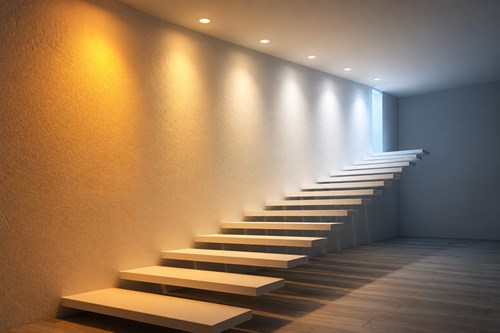
Minimalist cantilever staircase lit with tunable white downlights, showing the full white colour spectrum.
With tunable white, one light source can mimic different natural lighting conditions. It can be tailored to suit our individual requirements resulting in better comfort, productivity, wellbeing, and design flexibility.
How Tunable White Lighting Works
This non-static lighting technology is more complex than traditional static LED light sources, and requires blending mixed colour LEDs together along with a compatible control system. We’ve looked at what tunable white lighting is and why you need it - now let’s find out exactly how tunable white allows you to achieve the specific light colour and intensity that you want.
LED Mixing & Blending
The brightness and colour of a tunable white lighting scheme are controlled independently of one another; this ensures that the colour of the light stays the same even when the scheme is dimmed or brightened.
- Tunable light fixtures contain sets, or arrays, of different colour LEDs mixed together on the same board, e.g. warm white mixed with cool white.
- Adjusting the ratio of warm white to cool white LEDs, as well as adjusting the intensity of each individual LED, changes the colour temperature output of each fixture and the lighting scheme as a whole.
Control Systems (Drivers, DALI, Casambi, WiFi)
A compatible control system is essential and consists of:
Drivers:
A tunable white LED driver receives commands from the control system and:
- Regulates the relative output of the arrays of LEDs to achieve the desired CCT (e.g. 6500K cool white to replicate daylight).
- Regulates the overall output to achieve the required brightness (e.g. 300-500 lux for optimal productivity according to the BS EN 12464-1:2021 standard).
Control Unit:
Popular controls include:
The user interface can be a simple wall switch or sliders, or via the control system app on your smart phone or tablet.
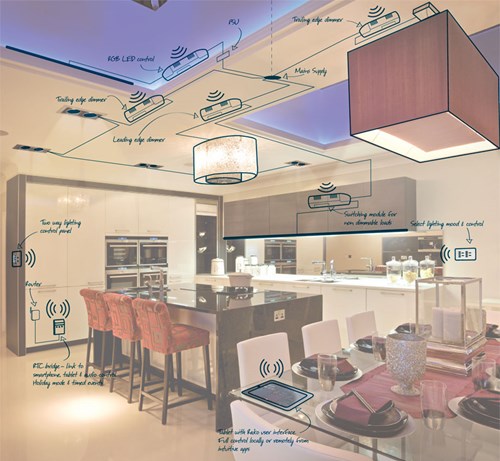
A wiring sketch over the top of an open-plan kitchen.
Tunable White Lighting Automation
Tunable lighting systems can be operated manually but they deliver their best results when you set up pre-programmed scenes. Automated scenes created using smart controls can automatically adjust indoor lighting CCT and intensity to:
- Motivate productivity & focus
- Create a calming environment
- Support our natural circadian rhythm
Smart tunable lighting technology can also use time, date and GPS geolocation data to regulate the body’s 24-hour biological clock by replicating and working in harmony with:
- The natural light dynamics of the day-night cycle
- Weather patterns
- Seasonal variation
And for total control, automated scenes and settings can be instantly overridden at the touch of a button when needed.
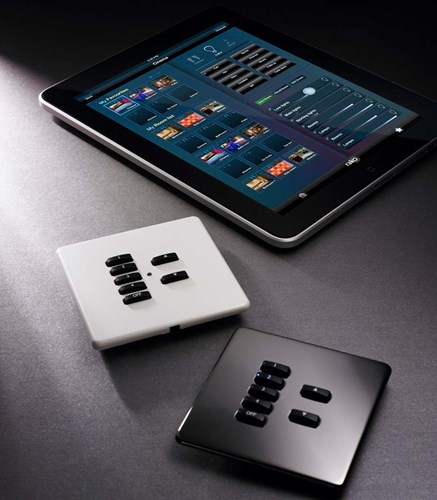
Automated systems can be overridden using lighting switches or apps.
Tunable White vs Dim-to-Warm vs RGB Lighting
Tunable white isn’t the only dynamic LED lighting available, so how does it differ from other options? Let’s compare the three main types:
| Feature | Tunable White | Dim-to-Warm (“Warm Dim”) | RGB (“Colour Changing”) |
|---|---|---|---|
| Colour Range | White only (typically 1800K–6500K) | White only, shifts warmer as dimmed | Full visible spectrum, incl. non-white colours |
| Brightness vs colour control | Independent — colour stays fixed unless changed | Linked — colour warms automatically with dimming | Independent |
| Typical purpose | Functional — wellbeing, circadian support, productivity | Functional/aesthetic — mimics incandescent dimming | Decorative — mood and visual impact |
| Best suited to | Offices, healthcare, schools, HCL schemes | Homes, hospitality — anywhere wanting an incandescent "feel" | Restaurants, theatres, theme parks, retail displays |
| Control complexity | Requires compatible driver + control system (DALI, Casambi, etc.) | Simple — built into driver behaviour, no extra control needed | Requires compatible driver + control system |
Tunable White
- Adjustable white light only, not multi-coloured
- Its brightness & colour change independently of each other
- Subtle, functional changes.
Dim-to-Warm LEDs (“Warm Dim”)
- White LED light which becomes a warmer white colour when dimmed
- Similar appearance to incandescent lamps when dimmed
- Light intensity cannot be changed independently of colour temperature.
RGB Lighting (“Colour Changing Lights”)
- Changes colour temperature across the entire visible spectrum including colours other than white
- More decorative than functional
- Used in restaurants, theatres, theme parks etc.
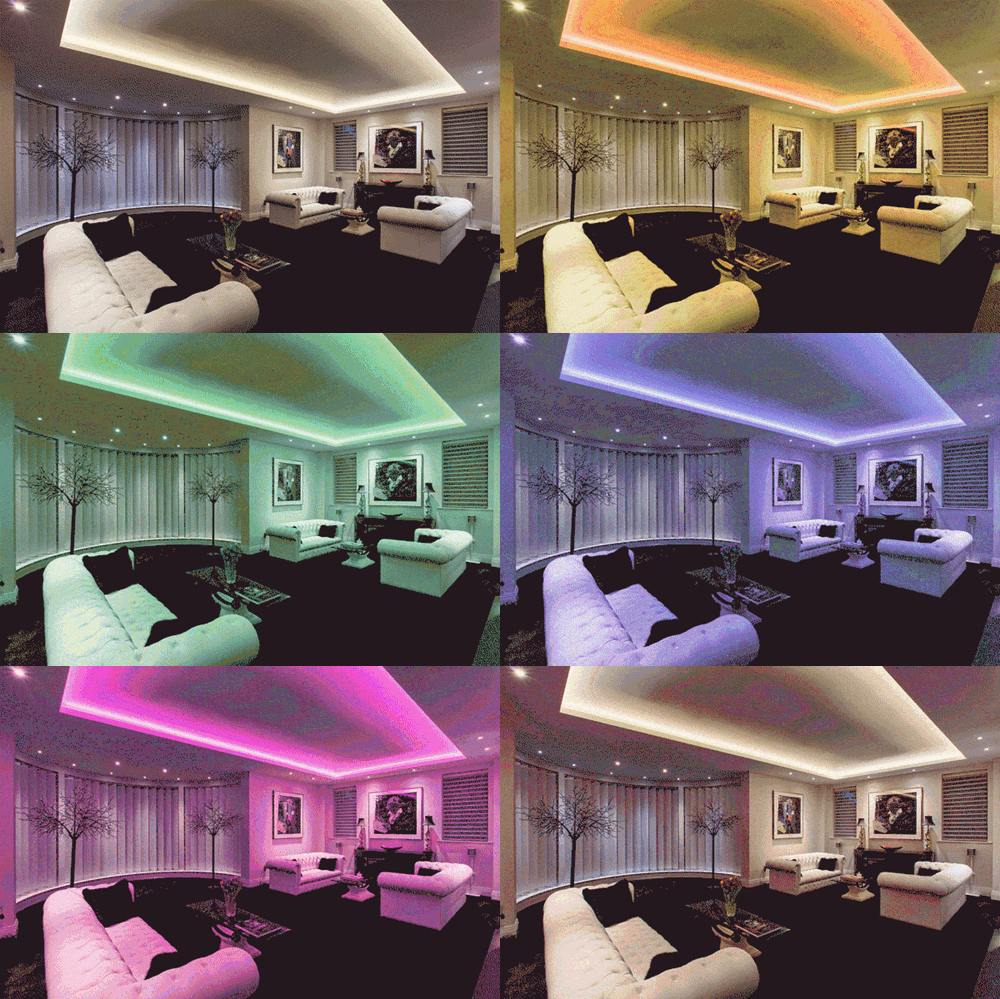
Animated gif showing RGB LED tape cycling through the colour spectrum.
Tunable White lighting technology is more state-of-the-art than other non-static LED lighting: it offers control, flexibility and human-focused benefits and is far more than just a decorative ‘nice-to-have’.

Light has a profound influence on human wellbeing and our perception of space. While artificial lighting cannot fully recreate the experience of being outdoors, Tunable White technology enables us to introduce a more natural rhythm of light into interior environments, supporting circadian health and responding more sensitively to the way humans experience light throughout the day.

- Santi, Darklight Design Lighting Designer
The Future of Tunable White Lighting
Tunable white light is now an essential part of our modern lighting schemes and smart, human centric environments. Tunable white offers us more than static LEDs including health and productivity benefits, as well as biodynamic settings which change automatically throughout the day but can be manually overridden when needed. With so many applications known already, we’re excited to discover what other future benefits this dynamic technology will offer us in our healthcare settings, workplaces, retail environments and homes - the future looks bright with tunable white.
FAQs
Q. What does CCT stand for in tunable white lighting?
CCT stands for correlated colour temperature, measured in Kelvin (K). It describes the appearance of white light, from warm tones around 1800K (candlelight) to cool tones around 6500K (daylight). Tunable white lighting lets you select and change the CCT to suit the time of day, task or mood.
Q. What CCT range does tunable white lighting typically cover?
Tunable white lighting typically ranges from around 1800K to 6500K. At the warm end, 1800K resembles candlelight, while 2700K gives a cosy warm white. At the cool end, 6500K replicates daylight. Unlike fixed-CCT LEDs, tunable systems offer a continuous range rather than preset colour temperatures.
Q. What is the difference between tunable white and dim-to-warm lighting?
Tunable white lets you adjust brightness and colour temperature independently, so the light colour stays consistent at any dim level unless you choose to change it. Dim-to-warm LEDs automatically shift to a warmer colour as they dim, mimicking incandescent lamps, but brightness and colour can't be controlled separately.
Q. Is tunable white lighting the same as human centric lighting?
Not quite — tunable white lighting is the technology, while human centric lighting (HCL) is the design approach that uses it. HCL combines tunable white LEDs, natural daylight and lighting design to support circadian rhythm, mood and wellbeing throughout the day, replicating patterns of natural light.
Q. What control systems work with tunable white lighting?
Tunable white fixtures need a compatible control system to regulate CCT and brightness. Common options include wired protocols like DALI, and wireless systems such as WiFi, Bluetooth or Casambi. These can be operated via wall switches, sliders or an app, and support automated, pre-programmed lighting scenes.
Q. Can tunable white lighting be controlled automatically?
Yes. Tunable white systems can run pre-programmed scenes that automatically adjust CCT and brightness throughout the day, often using time, date and GPS data to mimic natural daylight, weather and seasonal changes. These automated scenes can still be manually overridden at any time.
So What's Next?
- Read more posts on Human Centric Lighting
- Discover our Lighting For Health range - a curated collection designed to support Human Centric Lighting projects.
- Ready to start your HCL project? Or still have questions?
Contact us on 01189 882294 or [email protected]
We're happy to help :)